• Hollow block construction of homes is unsafe if there are no steel bars or wire mesh in between? This is why many houses in 3rd world countries collapse easily during an earthquake or even just a strong typhoon.

    Using a steel wire mesh or a steel frame or simply dropping rebar rods into every other cell of the hollow block for reinforcement however means a much safer home, especially in earthquake prone Philippines.

    Learn how to properly reinforce a hollow concrete block wall here.
    ******************

    Moreover, steel is 100% recyclable, even if it is old and rusted and looks like junk already, it is still fully recyclable.

    What’s more, the steel frame is not only strong enough to keep your walls from collapsing during thunderstorms, it also provides a path for the lightning to go straight to the ground should your house be struck.

    Lastly, your living area can actually be much bigger since huge columns will no longer be necessary because a steel frame is strong enough for wide open spaces.

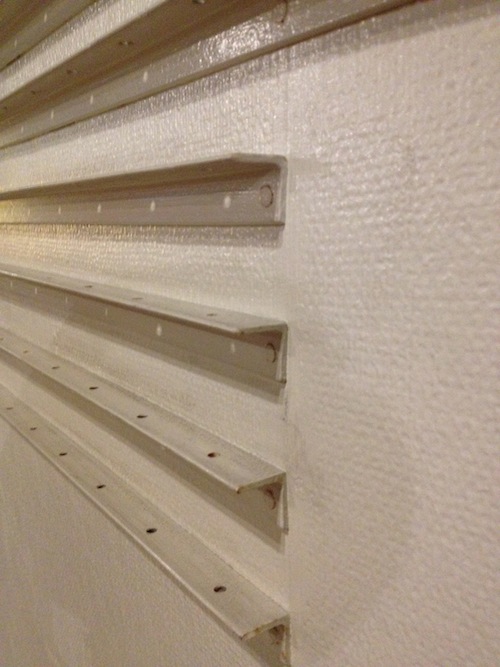
  • A visit to a Bacolod furniture showroom recently yielded a nice surprise- angular bars adorned the walls both for form and function. Aesthetically pleasing, minimalist and unobtrusive, the angle bars were painted white against a white background and placed horizontally as a design feature on the wall.

    Holes were then drilled into them so that different size picture frames and mirrors could be hung without having to drill into the walls.

    Brilliant!

  • After having the the Church of San Sebastian destroyed by fire and earthquakes in 1859, 1863, and 1880, Estebán Martínez, the parish priest of the ruined church, decided to ask Spanish architect Genaro Palacios to build a fire and earthquake-resistant structure.

    This meant the basilica could therefore not be made of wood or brick (the material they used in the 3 earlier iterations).  So Palacios recommended a daring and visionary material.  He suggested that the church should be made entirely of steel. Moreover, the steel structures would be prefabricated in Belgium. According to the historian Ambeth Ocampo, the knockdown steel parts were ordered from the Societe Anonyme des Enterprises de Travaux Publiques in Brussels and all in all, 52 tons of prefabricated steel sections were transported in eight separate shipments from Belgium to the Philippines with the first shipment arriving in 1888.

    Around the same time (two years earlier), another steel structure that would become world famous had been built in Paris as the grand entranceway to the World Fair. This massive tower that millions would later ascend and descend (to this day) was designed by Gustave Eiffel. Historian Ambeth Ocampo while doing research in Paris, posited that possibly the San Sebastian Church in Quiapo was also designed by Eiffel because of his fascination with steel structures. Other historians concur with this supposition because no other architects at that time (late 1800’s) were undertaking such enormous projects using steel as the primary material.

    Today, like its counterpart in Paris, the Basilica of San Sebastian still stands proud in the Plaza del Carmen at the eastern end of Claro M. Recto Street in Quiapo, Manila. Although after over 120 years, the salty sea breeze wafting in from the Manila Bay is corroding some of the exposed steel (but better than being burned down or destroyed by earthquake every few years as had happened before).

    In 1973, the government proclaimed the church as a National Historical Landmark, and since 2006 is on the tentative list for inclusion as one of UNESCO’s World Heritage Sites for its Architectural Design.

  • Pinoy Engineer Bow Moreno has succeeded in designing a building system that allows him to finish a 72-square-meter, 24 foot-high, two-story townhouse with a spacious attic in just 12 days and for less than P680,000. To prove it, his company, Bow Moreno Construction, delivered 10 townhouses in 120 days (exactly as promised) for the GMA-7 Employees Multipurpose Cooperative.

    SO, HOW DID HE DO THIS?
    In the article from the Philippine Daily Inquirer, Moreno explains how he has developed a system called “buil-to-order-web” or BOW building system which takes advantage of the versatility of the steel angle bar. He has put together a clever steel system that when built a certain way will have the strength equal to that of I-Beams but are lesser in cost.

    VALUE ENGINEERING
    Some methods the BOW system uses include 3 x 3-inch angular bars welded together and joined by round steel bars to form 3 x 6-inch channels that serve as columns and beams. These can then be easily assembled to form the skeletal frame of the house.

    The concrete framework is then clad with MX panels consisting of corrugated Styrofoam boards sandwiched by an interconnected pair of galvanized wire mesh which are plastered with cement using pressurized bucket spray for strong & efficient bonding.

    Moreno also explains how he does the flooring and roofing. You can read more about his method by reading the article here and start thinking of ways you can also save with steel.

  • In this article by NEDA, they show a 2-storey experimental house with a total floor area of 53 square meters constructed utilizing coconut fiber-cement boards (CFB) together with component steel as its structural framework.

    Given the plentiful coconut tree- ubiquitous in fact on our Philippine shores, CFB as an alternative construction material for walling, ceiling, roofing and base support in upper level flooring of house makes complete sense. In fact, NEDA proposes its use in the fabrication of furniture (tables, chairs, desks, etc.), cabinets, boxes and vases inside the house.

    Roofing System

    MATERIALS USED: The house has an A-frame design with the roof system consisting of the traditional rafters and purlins construction. In the picture, the green roof cover is made of 8 mm thick, 75 cm wide, and 75 cm long CFB panels painted with waterproof paints.

    The rafters consist of 0.6 cm X 5 cm x 5 cm angular steel bars and the purlins made of 0.60 cm x 3.8 cm x 75 cm channel bars. The components were assembled on site by welding the members together. The two opposite rafters were joined together end to end at the ridge beam (0.60 cm x 5 cm x 5 cm angular steel bar) while the other ends were directly connected to the base plate of the second level floor extending to the eaves or overhang of about one (1) meter.

    Interestingly, the main roof structure was made to incline by about 40% greater than the normal slope of 35 degrees considering that the roof cover is made of experimental fiber-cement boards. This will ensure faster surface water run-off in case of downpour.

    Of course, the question is, how strong and lasting is the coconut fiber? This project by NEDA aims to evaluate the performance of CFB in actual service condition. To find out more click here

    Note: A coconut fiber-cement board (CFB) is a product manufactured from fibrous materials like coconut coir, fronds, spathes and shredded wood that are mixed with Portland cement at a predetermined ratio of 60-70% cement to 30-40% fiber by weight.

  • Myphilippinelife.com (2025 update: website has unfortunately been removed) has put together a wonderful tutorial on the standard Philippine roofing system. They explain what angle bars they use, when c-purlins were appropriate and the like. The pictures tell the tale though and it’s wonderful to see how they build the roof with a blow-by-blow account. They even have the prices they paid for their materials. They also warn, as we’ve been warning our customers, against substandard steel, “So when shopping for steel in the Philippines, you have to be on your toes. Some, perhaps even most suppliers will automatically ship you substandard steel unless you are educated and persistent.” It’s not cheaper when you’re getting something of inferior quality that could be harmful to your safety in the long run.

    Best of all, they walk us down the history of Philippine roofs at the end of the article. Treating us not only to an excellent “how-to-guide” but also a walk down memory lane.

  • We are all doing our part to make this world more sustainable for our increasing population. Steel is actually part of the answer because it is 100% recyclable unlike plastic, paper, or even glass. You can take the most rusted worn out bent out of shape steel scrap and once it’s gone into the smelter it can come out again as a brand new piece ready to be used.

    Steel is also sturdy, wear and tear resistant, durable, has a smooth finish and if you buy it from PS Licensed and BPS certified companies such as 21st Century Steel, guaranteed to be dimensionally correct in size and weight.

    There are many different applications for steel which encompasses anyone from ship builders and auto parts to scaffolding and building structural uses.

    So if you’re thinking about whether to go with wood or with steel for your door frames, window frames or even furniture, consider going with the more environmentally conscious choice! Choose Steel!

  • (1) CHEAPER
    Once upon a time (translation: before the 1970’s), wood was used extensively in the Philippines for top cords, trusses and purlins. With the population boom and our forest decline however, wood is now simply too expensive to use.

    (2) EASIER
    Contractors, architects and designers started encouraging the use of angle bars for trusses and c purlins where the roofing plates are then screwed in. It is not only cheaper, but much easier to put together. Some even go as far as using GI pipes welded together in very simple roofing systems.

    (3) NO MORE TERMITES
    As we all know, termites abound in the Philippines and you never know when wood in your structure is being eaten away until sometimes way too late. The use of steel spares homeowners from termite infestations aside from being cheaper, easier to construct and always readily available.

    (4) MORE OXYGEN FOR US
    The use of steel over wood means the protection of our forest cover- to cleanse our air, to provide oxygen, to keep animals safe, among a host of other things.

  • SASSMAPI (Steel Angles, Shapes & Sections Manufacturers Association of the Philippines, Inc.) Vol. 1 Series 2010

    Panimula

    Ang Steel Angle Bars ay pangunahing ginagamit sa straktura at konstraksyon kaya ang kalidad nito ay mahalaga upang mapangalagaan ang kaligtasan ng publiko.  Upang maksasiguro na may kalidad ang binibiling bakal kaliangan ito ay kumokomporme sa Philippine National Standards.

    Babala

    Ang equal-leg steel angle bars ay napapailalim sa mandatory certification ng PNS 657:2008 kaya ang sinuman gumaga, nag aangkat, bumibili at gumagamit ng uncertified angle bars ay may pananagutan sa batas sangayon sa DAO 2:2007. Kelanga din na mayroong Import Commodity Clearance (DAO 5:2008) para sa mga importers at PS License (DAO 4:2008) naman para sa Local Manufacturers.

    Ipag-bigay alam sa pinakamalapit na DTI-BPS office ang sinumang gumagawa, nagbebenta at gumagamit ng uncertified steel angle bars.

    MAPANGANIB
    Ang bakal na hindi kumokomporme sa standards ay maaring magdulot ng malaking pinsala sa ari-arian at pagkawala ng buhay. Kaya siguraduhing certified angle bars lang ang binibili at ginagamit.

    PALATANDAAN NG UNCERTIFIED ANGLE BARS
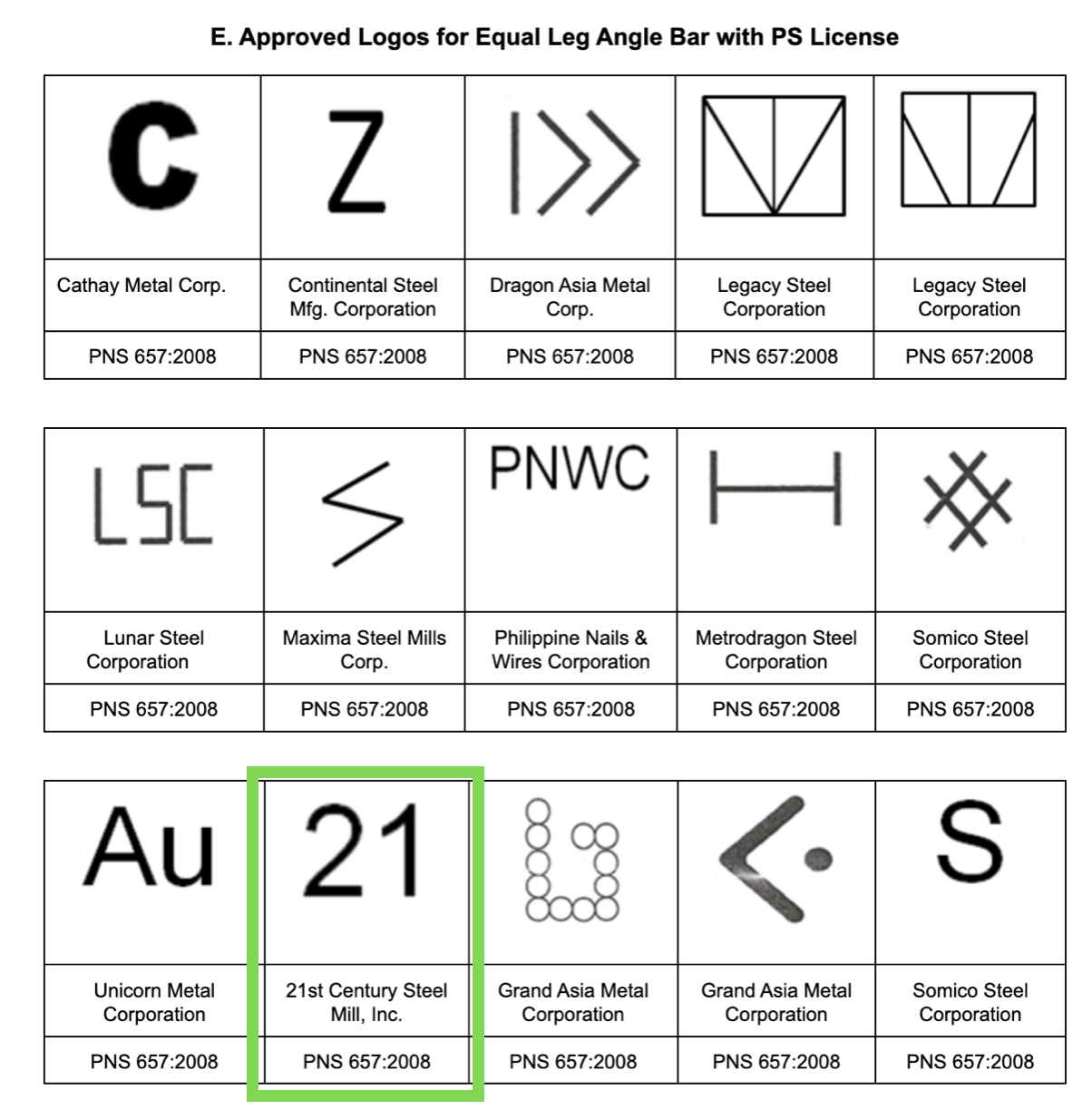
    1. Walang marka/logo na nagsasaad ng kumpanyua na gumawa ng bakal, leg dimension at grade. Note: Dapat ang logo ng kumpanya ay naka rehistro sa Bureau of Product Standards.

    2. Kulang sa timbang at sukat.

    3. Kailangan tama ang kulay sa magkabilang dulo at naaayon sa color coding ng kapal ng angle bar.

    Bumili lang ng equal-leg steel angle bars na gawa ng mga kumpanya na may PS License na pinagkaloob ng Bureau of Product Standards ng Department of Trade & Industry.

    21st Century Steel Mill, Inc. is PS Licensed and BPS Certified.

  • BusinessMirror
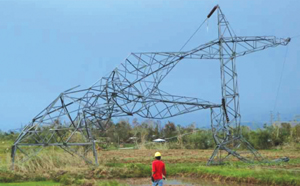
    We cannot stop the wrath of mother nature and we will never win a battle against her. But often times, we also blame her for things that are our own fault. When Supertyphoon Juan hit last 2010, 15 steel towers on the Gamu-Tuguegarao line toppled.

    First we would like to find out if the materials used were substandard. And if they are substandard, determine if they are locally made or imported. Being responsible corporate citizens, we cannot just sit back knowing that this is hazardous to life and property, aside from causing disruption to the delivery of power to communities
    and business establishments
    ,” said Maria Victoria Padilla, executive director of PPSQF (Philippine Product Safety and Quality Foundation)

    In a separate case in Batangas City, Padilla reported the , seizing of substandard steel goods amounting to 1 million pesos (of which over 700,000 were subsequently sold). Padilla reiterated that “substandard steel angles in the market puts the lives and properties of the public at risk” and said the government together with the private sector must work together to put a stop to its proliferation.